
Top 10 Cable Wire Types Global Buyers Need to Know
Choosing the right cable wire types can determine whether a project runs safely, efficiently, and reliably for years. Global buyers must look beyond price, color, and packaging. A cable used inside a control cabinet faces different demands from one buried underground or exposed to sunlight. Copper, aluminum, coaxial, fiber optic, twisted pair, and flexible cables each serve distinct purposes. The wrong selection may create heat, signal loss, mechanical damage, or costly replacement work.
Details matter.
This guide introduces the top 10 cable wire types global buyers need to know. It considers conductor materials, insulation, shielding, flexibility, voltage ratings, environmental resistance, and installation conditions. For example, a factory cable may need oil resistance and repeated bending performance. An outdoor data cable may require UV protection and stable signal transmission. Buyers should also verify test reports, product markings, traceability, and supplier experience before placing large orders. A “cable wire cable” listing may sound useful, but vague terminology can hide major specification differences. Ask for technical datasheets and samples.
Standards vary by market.
Certifications should match the destination country and the intended application. However, compliance labels alone do not guarantee good performance. Installation quality, storage conditions, and connector compatibility also influence service life. This overview is practical, yet no general list can replace an engineer’s assessment. Some recommendations may change as technology, standards, and project conditions evolve. That limitation deserves attention. Reliable purchasing comes from comparing evidence, not trusting confident claims.
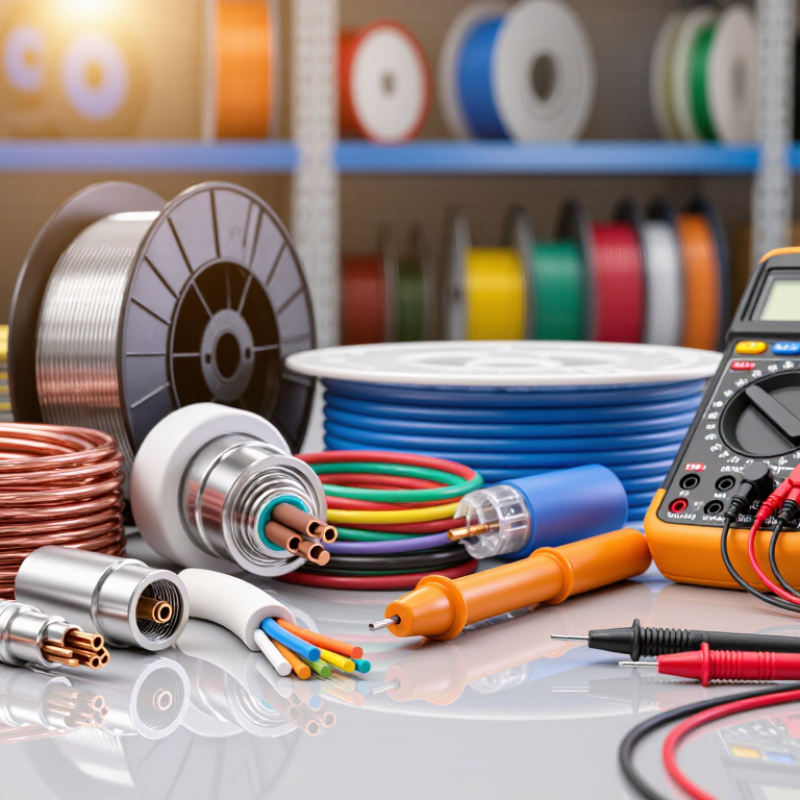
Cable and Wire Basics: Definitions, Structures, and Global Standards
A wire is typically one conductor, while a cable contains one or more insulated conductors. Market usage varies, so buyers should confirm the supplier’s definition. The conductor carries current and usually uses copper or aluminum. Insulation controls voltage separation. A sheath adds protection against moisture, abrasion, chemicals, and sunlight.
Structure affects performance. Solid conductors suit fixed installations and simple routing. Stranded conductors bend more easily, especially inside machines, panels, and moving equipment. Some cables include shielding, fillers, armor, or drainage wires. These layers are not decorative. They manage electromagnetic interference, crushing forces, heat, and installation stress. A cable may look thick, yet still have limited flexibility.
Global standards require careful comparison. IEC 60228 classifies conductor construction and resistance. Power cables may follow IEC 60502-1, while other applications use different regional or product-specific standards. North American requirements can differ from IEC practices in testing, markings, and certification. Do not treat one approval as universal. Ask for voltage ratings, temperature limits, flame performance, conductor class, and test reports.
In procurement reviews, I often see buyers compare price before structure. That approach can fail. A cheaper cable may need larger bends, extra shielding, or earlier replacement. Check the installation drawing, ambient temperature, bending radius, and termination method. Labels can be incomplete. No checklist is perfect. I still recommend matching every technical claim with a current document, not a sales description. Small wording differences can change the correct cable type.
| No. | Cable or Wire Type | Basic Definition | Typical Structure | Common Conductor Materials | Insulation and Sheath | Typical Applications | Common International or Regional Standards | Buyer Considerations |
|---|---|---|---|---|---|---|---|---|
| 1 | Building Wire | Insulated single-core wire used for fixed electrical wiring in buildings and equipment. |
|
Copper or aluminium | PVC, thermoplastic, or cross-linked insulation depending on the rating. | Distribution boards, conduits, lighting circuits, sockets, and fixed internal wiring. | IEC 60227-3; IEC 60228; UL 83; NFPA 70 requirements where applicable. | Confirm conductor class, voltage rating, flame performance, installation method, and local color identification rules. |
| 2 | Low-Voltage Power Cable | Multi-core or single-core cable designed to transmit electrical power at low voltage. |
|
Copper or aluminium | PVC or XLPE insulation with PVC, LSZH, or other approved outer sheath. | Industrial distribution, commercial buildings, utilities, machinery, and underground or tray installations. | IEC 60502-1; IEC 60228; EN 50575 for certain construction-product applications; national wiring codes. | Check rated voltage, conductor size, current capacity, short-circuit rating, bending radius, sheath resistance, and installation environment. |
| 3 | Medium-Voltage Power Cable | Power cable with a screened insulation system for distribution networks above low-voltage levels. |
|
Copper or aluminium | Normally XLPE or EPR insulation with semiconductive screens and a PVC, PE, or LSZH sheath. | Utility feeders, substations, industrial plants, renewable-energy collection systems, and underground networks. | IEC 60502-2; IEC 60840 for certain higher-voltage cable systems; IEC 60228; applicable utility specifications. | Evaluate partial-discharge performance, screen design, water blocking, metallic screen fault-current capacity, accessories, and test documentation. |
| 4 | Control Cable | Multi-core cable used to carry control, switching, and monitoring signals in industrial systems. |
|
Usually tinned or bare copper | PVC, XLPE, PUR, or LSZH insulation and sheath, selected for flexibility and environment. | Motor control centers, automation panels, production lines, process equipment, and building-management systems. | IEC 60502-1; IEC 60228; IEC 60332 flame tests; UL 1277 or other national requirements when specified. | Specify core count, conductor class, screen requirement, oil resistance, flexing cycles, EMC performance, and fire rating. |
| 5 | Instrumentation Cable | Low-energy cable designed to transmit accurate analog, digital, or process-control signals with reduced interference. |
|
Annealed copper, often tinned for specific environments | PVC, PE, XLPE, fluoropolymer, or LSZH materials; optional armouring for mechanical protection. | Temperature, pressure, flow, and level transmitters; distributed control systems; refineries and process plants. | IEC 60079-14 for applicable hazardous-area installations; IEC 60332; IEC 60754; IEC 61034; project-specific instrumentation standards. | Check capacitance, impedance balance, shielding method, intrinsic-safety requirements, drain-wire design, and separation from power cables. |
| 6 | Solar Photovoltaic Cable | Outdoor-rated cable intended for the direct-current side of photovoltaic power systems. |
|
Usually tinned copper; aluminium versions may be used in selected systems. | Cross-linked polyolefin or other UV-, ozone-, weather-, and temperature-resistant materials. | PV module interconnections, string wiring, combiner boxes, trackers, and DC collection circuits. | IEC 62930; EN 50618; IEC 60228; IEC 60332-1-2; UL 4703 where required by the installation market. | Verify DC voltage rating, temperature range, UV resistance, wet-location performance, conductor flexibility, connector compatibility, and service life. |
| 7 | Flexible Cord and Portable Cable | Flexible cable designed for portable equipment, temporary connections, or repeated movement. |
|
Fine-stranded copper | PVC, elastomer, rubber, PUR, or other flexible compounds. | Portable tools, appliances, extension leads, stage equipment, industrial machines, and movable installations. | IEC 60227-5; IEC 60245-4; IEC 60228; relevant national appliance and flexible-cord requirements. | Review flexing class, abrasion and oil resistance, plug compatibility, temperature rating, conductor identification, and outdoor suitability. |
| 8 | Coaxial Cable | Transmission cable with a central conductor and concentric shield separated by a dielectric. |
|
Copper, copper-clad steel, or other specified conductive materials | Solid or foamed polyethylene dielectric with PVC, PE, or LSZH jacket. | Radio-frequency systems, antennas, video distribution, broadband networks, test equipment, and instrumentation. | IEC 61196 series; IEC 60728 for certain cable-network applications; applicable RF and national installation standards. | Match characteristic impedance, commonly 50 or 75 ohms, and check attenuation, return loss, shielding effectiveness, frequency range, and connector type. |
| 9 | Balanced Twisted-Pair Data Cable | Communication cable formed from twisted insulated conductor pairs to reduce electromagnetic interference and crosstalk. |
|
Solid or stranded copper; copper-clad aluminium is not equivalent to solid copper for many structured-cabling requirements. | Polyethylene or polyolefin insulation with PVC or LSZH jacket. | Ethernet networks, structured cabling, industrial Ethernet, building automation, and data centers. | ANSI/TIA-568.2-D; ISO/IEC 11801; IEC 61156 series; EN 50173 where applicable. | Specify category or class, bandwidth, insertion loss, NEXT, return loss, shielding configuration, PoE support, and permanent-link testing. |
| 10 | Fiber-Optic Cable | Communication cable that transmits information as light through optical fibers instead of electrical current. |
|
Silica glass for most telecom and data-network fibers; polymer optical fiber is used in selected short-range applications. | UV-cured acrylate coating with PVC, LSZH, PE, or other protective outer materials. | Telecommunications, data centers, access networks, industrial communications, security systems, and long-distance links. | IEC 60793; IEC 60794; ISO/IEC 11801; ITU-T G.652, G.657, or other applicable fiber recommendations. | Choose single-mode or multimode fiber, fiber count, bend sensitivity, attenuation, connector compatibility, pulling strength, fire rating, and indoor/outdoor construction. |
Related Posts
-
What Is Electrical Wire and Which Type Should You Buy?
-

2026 Top Electrical Cable Trends Innovations and Uses?
-
Top Wire Cable Types for Global Buyers in 2026?
-
Best Electrical Wire Types for Your Projects?
-
2026 How to Properly Use Cable Clamps for Secure Wiring Solutions?
-

Top 10 Power Wire Types You Need for Your Electrical Projects in 2023