Global sourcing makes control wire selection more complex than comparing price per meter. A wire suitable for a factory panel may fail in a robotic arm, outdoor cabinet, or high-temperature enclosure. Buyers must match conductor size, voltage rating, insulation material, flexibility, temperature range, and bending radius to the real installation. Small details matter.
Industry conditions also deserve attention. The International Energy Agency’s Electricity 2024 report expects strong global electricity demand growth, increasing pressure on electrical equipment supply chains. The International Copper Study Group’s recent market assessments also show continuing volatility in refined copper supply and demand. These trends can affect lead times, minimum order quantities, and material pricing. A low quotation may not remain economical after freight, testing, and replacement risks. That is easy to overlook.
A reliable control wire sourcing process should connect technical specifications with evidence. Request IEC, UL, or CSA compliance documents where applicable, plus conductor resistance, flame-retardance, insulation, and aging test results. IEC 60227 and IEC 60502 may guide relevant cable choices, but their suitability depends on the application and market. Regional requirements should never be assumed. Confirm RoHS and REACH declarations when the destination requires them. Review batch traceability, factory audit records, sample approval, and change-control procedures. Documentation is not decoration. In practice, even experienced buyers can miss connector compatibility or repeated flexing requirements. That weakness deserves review. The best decision balances safety, performance, availability, and total landed cost, rather than selecting the cheapest control wire.
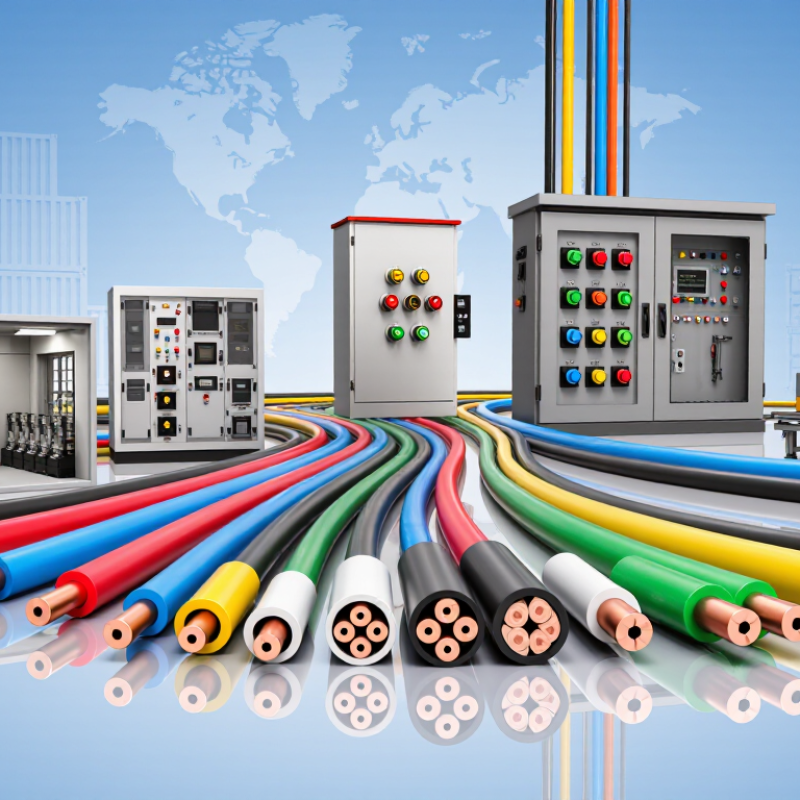
Start with the actual application load, not a guessed wire size. List continuous current, starting current, switching frequency, and expected duty cycle. A motor starter and a sensor circuit need different control wire. Record the highest working voltage, then check insulation ratings with a safety margin. Do not rely on nominal voltage alone. Long cable runs can create voltage drop, especially in low-voltage control systems. Measure the route length and calculate the drop before requesting quotations.
Flexibility depends on movement, bend radius, and installation space. A fixed cabinet may use a different conductor construction than a cable chain or moving panel. Temperature matters too. Review both ambient temperature and heat from nearby terminals, motors, or ducts. In humid, oily, dusty, or chemically exposed areas, select insulation that matches the environment. Outdoor routing also requires resistance to sunlight and moisture. I have seen suitable-looking wires fail because the jacket was chosen for the voltage, not the location. That mistake is easy to repeat.
Tips: Give suppliers a clear specification sheet with conductor size, voltage, strand class, insulation material, temperature range, color identification, and required test reports. Request samples before placing a large order. Test stripping, crimping, bending, and terminal fit with your actual tools. Recheck regional standards and documentation requirements before production. A low purchase price can become expensive after rework, delays, or rejected assemblies.
How to Choose Control Wire for Global Sourcing?
Global control-wire demand is rising with electrification. The IEA Electricity 2024 report forecasts average global electricity-demand growth of about 4% annually from 2024 to 2026. That growth increases the need for traceable, correctly rated wiring. Voltage rating is not a decoration on the datasheet. It defines the insulation’s tested service range.
IEC 60227 cables marked 300/500 V are designed for PVC-insulated applications within the IEC framework. The marking means 300 V conductor-to-earth and 500 V conductor-to-conductor. UL 1015 wire carries a 600 V rating and is commonly specified for internal equipment wiring under North American requirements. Its typical insulation temperature rating is 105°C in dry conditions, but buyers must verify the exact construction and certification file.
Do not treat them as interchangeable.
For global sourcing, check conductor class, insulation thickness, temperature rating, flame performance, bending radius, and test documentation. IEC 60227-1 and the relevant product section should match the intended installation. For UL 1015, confirm the recognized construction, required gauge, and equipment approval route. A 600 V label does not automatically make a wire suitable for outdoor exposure, oil, motion, or high humidity. That assumption causes trouble.
I would also request batch traceability and sample testing before volume orders. Standards reduce uncertainty, but they do not replace application review. The uncomfortable part is simple: the cheapest compliant-looking wire may become the most expensive choice after installation.
IEC 60227 300/500 V vs. UL 1015 600 V Insulation Ratings
IEC 60227 control wires are commonly specified at a nominal 300/500 V rating with PVC insulation and a typical maximum conductor operating temperature of 70°C. UL 1015 wires are commonly rated at 600 V and 105°C. Select the wire standard according to the target market, equipment approval requirements, voltage system, and operating temperature. Actual ratings can vary by construction and applicable certification conditions.
Global control-wire sourcing starts with the installation, not the catalogue diameter. IEC 60364-5-52 requires ampacity checks under real conditions, including ambient temperature, grouping, enclosure, and installation method. Copper resistance also rises with temperature. IEC 60287 provides the thermal calculation framework. My first sourcing worksheet ignored grouped cables. That shortcut was wrong.
For ampacity, select a conductor whose corrected capacity exceeds the design current. Apply every relevant correction factor, then verify terminal temperature ratings. For voltage drop, use ΔV = 2ρLI/A for single-phase circuits and ΔV = √3ρLI/A for three-phase circuits. Set a 3% target for sensitive control loads, where practical. A 5% total target is commonly used for less demanding circuits. These are engineering targets, not universal legal limits. The IEA Electricity 2024 report projects global electricity demand growth of about 3.4% annually through 2026. Small losses can become costly across expanding systems.
Tips: Record cable length, conductor material, load current, routing, and temperature before requesting quotations. Compare corrected ampacity, voltage drop, insulation rating, and test documentation. Ask for resistance data at the intended operating temperature. Do not trust a single “maximum current” figure. It may assume free-air installation. Recheck the design after changing conduit fill or cable grouping. This extra review feels slow, but sourcing errors usually appear later, during commissioning.
How to Choose Control Wire for Global Sourcing?
When sourcing control wire internationally, confirm the conductor class before comparing prices. IEC 60228 Class 2 uses stranded conductors with limited flexibility. Class 5 uses finer strands for repeated bending and easier installation. The difference is noticeable near terminal blocks. Class 5 bends smoothly, while Class 2 usually holds its shape.
Do not treat AWG and mm² as perfect equivalents. AWG 18 is commonly compared with 0.75 mm², but the values are not identical. AWG 16 is often matched with 1.5 mm², while AWG 14 is near 2.5 mm². Always check the manufacturer’s datasheet. Conductor resistance matters more than a rounded conversion. A small mismatch can increase voltage drop, especially in long control cabinets.
Inspect samples before approving a global order. Use a micrometer, weigh the conductor, and verify resistance at a controlled temperature. Ask for IEC 60228 test records and confirm whether the stated area is nominal or actual. I have seen cables labeled by AWG pass a visual check but fail resistance expectations. That is easy to miss. Also review insulation diameter, bend radius, temperature rating, and terminal compatibility. One detail remains uncertain: regional documentation may describe the same cable differently. Require a shared specification with both AWG and mm², conductor class, strand count, and resistance limits. Pricing can wait. Specification errors cannot.
| Typical AWG Reference | AWG Nominal Area (mm²) | Closest IEC 60228 Nominal Size (mm²) | IEC 60228 Class 2 Conductor | IEC 60228 Class 5 Conductor | Flexibility and Installation Guidance | Global Sourcing Checkpoint |
|---|---|---|---|---|---|---|
| 24 AWG | 0.205 | 0.20 | Stranded, non-flexible | Flexible, fine-stranded | Suitable for small-signal and low-current control circuits when the equipment specification permits this conductor size. | Confirm that the required metric size is 0.20 mm²; do not automatically substitute 0.22 or 0.25 mm². |
| 22 AWG | 0.326 | 0.35 | Stranded, non-flexible | Flexible, fine-stranded | Useful for compact control and instrumentation wiring with limited mechanical movement. | Verify conductor resistance, insulation diameter, terminal compatibility, and the specified metric cross-section. |
| 20 AWG | 0.519 | 0.50 | Stranded, non-flexible | Flexible, fine-stranded | Common size range for low-current control, signaling, and panel wiring. | Confirm whether the application requires a fixed-installation conductor or repeated-flexing construction. |
| 18 AWG | 0.823 | 0.75 | Stranded, non-flexible | Flexible, fine-stranded | Appropriate for many light-duty control circuits; current capacity depends on installation conditions and the complete cable design. | Do not use AWG ampacity tables alone; check the applicable installation standard and temperature rating. |
| 16 AWG | 1.31 | 1.5 | Stranded, non-flexible | Flexible, fine-stranded | Common control-wire range for fixed equipment and flexible machine wiring. | 1.31 mm² AWG is not the same as the IEC nominal 1.5 mm² size; specify the required standard explicitly. |
| 14 AWG | 2.08 | 2.5 | Stranded, non-flexible | Flexible, fine-stranded | Suitable for higher-current control and auxiliary power circuits where the wiring rules permit it. | Check terminal acceptance, outside diameter, conductor resistance, and the required voltage and temperature ratings. |
| 12 AWG | 3.31 | 4 | Stranded, non-flexible | Flexible, fine-stranded | Useful for larger control loads and auxiliary circuits; Class 5 is preferred where routing movement is expected. | Confirm whether the receiving market uses AWG, IEC metric sizes, or both in the purchasing specification. |
| 10 AWG | 5.26 | 6 | Stranded, non-flexible | Flexible, fine-stranded | Suitable for relatively high-current control or auxiliary power circuits, subject to the installation method. | Confirm lug and terminal size, bending radius, conductor temperature rating, and permissible voltage drop. |
| 8 AWG | 8.37 | 10 | Stranded, non-flexible | Flexible, fine-stranded | Generally selected for larger auxiliary circuits rather than compact signal wiring. | Specify the complete cable construction; conductor class alone does not define the cable’s ampacity or safety approval. |
| 6 AWG | 13.3 | 16 | Stranded, non-flexible | Flexible, fine-stranded | Used for higher-load auxiliary and control-power applications with suitable terminals and routing space. | Confirm the metric conductor size, insulation system, short-circuit rating, and applicable national wiring rules. |
| 4 AWG | 21.2 | 25 | Stranded, non-flexible | Flexible, fine-stranded | Requires careful consideration of bending radius, termination hardware, heat dissipation, and installation method. | Use the IEC nominal size directly in the purchase order when metric compliance is required. |
| 2 AWG | 33.6 | 35 | Stranded, non-flexible | Flexible, fine-stranded | For high-current auxiliary circuits and installations requiring substantial conductor capacity. | Confirm conductor resistance at 20 °C, conductor class, insulation temperature rating, and termination method. |
| 1/0 AWG | 53.5 | 50 | Stranded, non-flexible | Flexible, fine-stranded | Large conductor size requiring engineered routing, support, and compatible compression or mechanical terminals. | AWG 1/0 and IEC 50 mm² are close but not identical; approval should be based on the specified standard and measured performance. |
Control wire selection starts with evidence, not a polished datasheet. The European Commission confirms that RoHS restricts ten substances in electrical and electronic equipment. REACH is broader. ECHA’s Candidate List now contains more than 240 substances of very high concern. Ask for current declarations, material composition, and revision dates. A generic “RoHS compliant” statement is weak evidence.
Supplier audits should trace copper, insulation, terminals, and production lots. ECHA’s 2024 enforcement project reported non-compliance in 18% of inspected products. That figure deserves attention. Request batch-level test reports from an accredited laboratory. Check laboratory scope, sample identity, test method, and report authenticity. A certificate without traceability can hide a substitution.
Fire performance needs the exact application and test level. IEC 60332 evaluates flame propagation, while IEC 60754 examines corrosive halogen gases. IEC 61034 measures smoke density. These tests answer different risks. Do not accept “flame retardant” as a complete specification. Confirm conductor class, voltage rating, temperature range, bending cycle, and jacket material.
In my sourcing experience, one missing suffix caused more confusion than a failed negotiation. I still review this manually. Automated checks help, but they are not perfect.
Keep supplier declarations, audit photographs, purchase records, and retest schedules together. A certificate is only reliable when the wire in the carton matches the wire tested.