
Global buyers are rethinking how everyday food containers balance hygiene, visibility, durability, and environmental impact. A Sugar Storage Jar is no longer judged only by its appearance on a kitchen shelf. Buyers now examine material safety, sealing performance, capacity, labeling, breakage risk, and transport efficiency. Grand View Research reports that the global glass packaging market is expected to grow steadily through 2030, supported by demand for recyclable and reusable formats. This trend gives glass jars strong commercial relevance.
Market data also shows why product selection cannot rely on style alone. Smithers’ packaging sustainability research highlights growing pressure to reduce material waste, improve recyclability, and control supply-chain emissions. A clear glass jar may display white sugar attractively, but its weight can raise freight costs. A lightweight plastic option may reduce breakage, yet buyers must assess food-contact compliance and long-term clarity. Small details matter. Lid liners, thread quality, and moisture resistance often determine whether sugar remains free-flowing.
This article examines the top Sugar Storage Jar types for global buyers, including glass, PET, acrylic, ceramic, and stainless-steel designs. Each option serves different retail, hospitality, and household requirements. The discussion considers capacity, closure systems, appearance, durability, and regional purchasing expectations. However, no single jar fits every market. That assumption deserves testing. Supplier certifications and independent laboratory documentation should support every specification, especially for food-contact products. Practical samples still matter, because a catalog image cannot reveal a weak hinge, sharp rim, or poorly fitted seal.
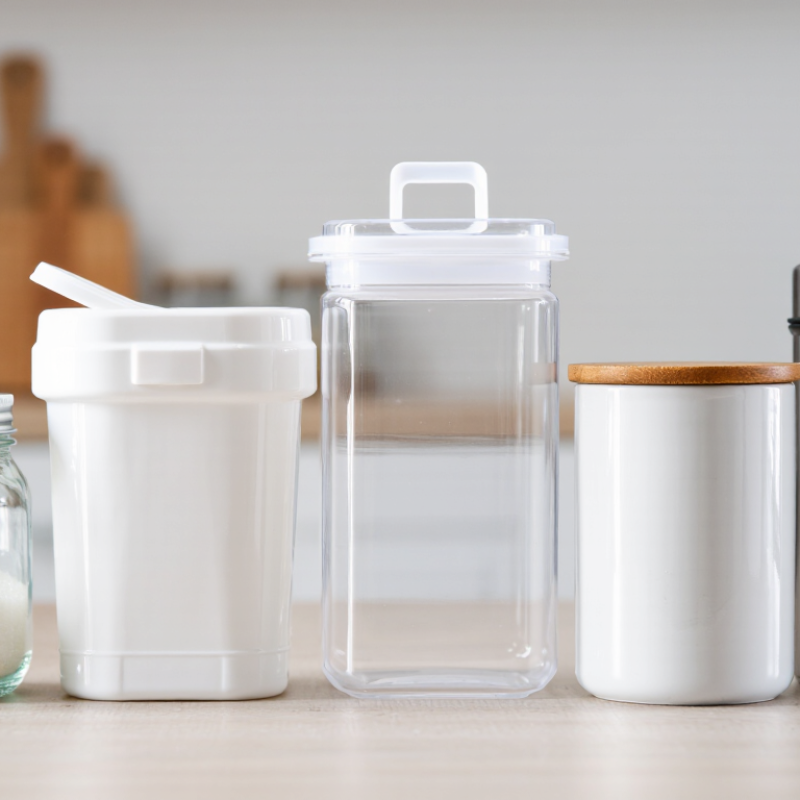
For global buyers, glass sugar jars combine clear presentation with dependable storage. Glass is a 100% recyclable material when local recycling systems accept it. It can be recycled repeatedly without losing its basic quality. This supports packaging programs that value material recovery and lower waste.
Food-contact safety needs careful checking. A suitable jar should use food-grade glass and pass migration testing for its intended use. The lid, gasket, paint, and printed decoration also require attention. These parts may touch sugar directly or indirectly. Ask suppliers for material specifications, test reports, and batch traceability.
In practical inspections, check for chips, sharp edges, trapped moisture, and uneven threads. Small defects can cause bigger problems during filling or transport.
Clear glass helps workers see sugar level, color, and possible clumping. Wide-mouth designs make scooping easier and simplify cleaning. Airtight seals are useful in humid kitchens, although no closure remains perfect forever. A jar can look excellent and still have a weak gasket. That detail is easy to miss. Buyers should test filled samples under real warehouse conditions before approving large orders. Recycling access also differs between countries, so local collection guidance deserves review.
PET sugar jars, with a density of about 1.38 g/cm³, offer a practical balance between strength and shipping weight. They are much lighter than glass, which can reduce handling effort and damage risk during long-distance transport. However, density alone does not determine the final package weight. Wall thickness, lid design, seals, and outer cartons also matter. A wide jar may use less material, yet occupy more container space. This detail is easy to overlook.
In warehouse use, clear PET helps staff check sugar levels without opening every container. The material also resists ordinary impacts during stacking and delivery. From practical packaging evaluations, secure lids and stable bases are just as important as lightweight construction. Food-contact suitability should be confirmed through current supplier documentation and relevant destination requirements. One concern remains: very thin walls may flex under pressure. My first shipping estimate was too optimistic because I ignored carton void space.
Tips: Compare complete packed weight, not jar weight alone. Request samples before placing a large order. Test lids after repeated opening and closing. Check whether the jar fits standard shelves and filling equipment. Use dividers when cartons travel through several handling points. A small design change can prevent large losses.
For global buyers, PP sugar jars offer a practical balance between low weight and everyday durability. Their density is approximately 0.90 g/cm³, according to ISO 1183-1 testing methods. This makes them lighter than glass while still providing useful impact resistance during shipping and storage. A filled jar feels solid, but not unnecessarily heavy.
Closure design needs closer attention. Screw caps support repeated opening and better thread control. Flip-top lids allow quick pouring with one hand. Snap-fit closures can reduce assembly steps, although their seal may weaken after rough handling. A silicone or polymer gasket can improve moisture protection, especially in humid kitchens. Small details matter here. The wrong lid ruins a good jar.
Packaging decisions should also consider end-of-life performance. The OECD’s Global Plastics Outlook projects global plastic waste could rise from 353 million tonnes in 2019 to 1,014 million tonnes by 2060. PP jars should therefore use clear material identification, simple structures, and minimal mixed components where possible. In practical sourcing tests, buyers should check lid torque, drop resistance, stack stability, and powder leakage. One weakness remains: a lightweight jar may flex under pressure. That is not always a defect, but it requires careful wall-thickness and closure testing before large-scale orders.
| Jar Type | Typical Material | Approx. Density | Common Capacity Range | Closure Options | Key Advantages | Buyer Considerations |
|---|---|---|---|---|---|---|
| PP Sugar Jar | Polypropylene (PP) | Approximately 0.90 g/cm³ | 250 mL–5 L | Screw cap, snap-fit lid, flip-top, hinged lid, or tamper-evident closure | Lightweight, impact-resistant, low moisture absorption, and suitable for household food storage | Check food-contact compliance, lid fit, hinge durability, and sealing performance |
| PET Sugar Jar | Polyethylene terephthalate (PET) | Approximately 1.37–1.40 g/cm³ | 250 mL–3 L | Screw cap, dispensing cap, or induction-seal-compatible closure | High clarity, good stiffness, and effective visual product presentation | May be less tolerant of high heat; confirm processing and storage temperature limits |
| HDPE Sugar Jar | High-density polyethylene (HDPE) | Approximately 0.94–0.97 g/cm³ | 500 mL–5 L | Screw cap, snap lid, or tamper-evident closure | Tough, lightweight, moisture-resistant, and suitable for opaque or translucent designs | Usually provides less transparency than PET; evaluate wall thickness and rigidity |
| Glass Sugar Jar | Soda-lime glass | Approximately 2.4–2.6 g/cm³ | 250 mL–2 L | Screw cap, clamp lid, or gasketed glass-compatible closure | Non-porous, highly transparent, and resistant to odor retention | Heavier and more breakable; packaging protection may increase shipping costs |
| Stainless Steel Sugar Canister | Food-grade stainless steel | Approximately 7.7–8.1 g/cm³ | 500 mL–3 L | Push-on lid, hinged lid, or silicone-gasket lid | Durable, opaque, corrosion-resistant, and suitable for light-sensitive contents | Higher weight and cost; verify steel grade, gasket material, and edge finishing |
Note: Density and capacity figures are typical material or market ranges. Actual jar performance depends on resin grade, wall thickness, molding process, closure design, and applicable food-contact regulations.
Ceramic sugar jars suit humid kitchens when their glaze is continuous and low-porosity. USDA Foreign Agricultural Service’s November 2024 Sugar: World Markets and Trade report forecasts roughly 186 million metric tons of global sugar production for 2024/25. That scale makes moisture protection a practical purchasing issue, not only a styling choice. Sugar can cake when humid air enters through tiny surface defects or a loose lid.
Look closely at the glaze. A smooth, sealed surface should feel cool and glass-like, without pinholes, rough patches, or exposed ceramic around the rim. Ask suppliers for water-absorption test results and production-batch records. ISO 10545-3 is designed for ceramic tiles, but its absorption method can help structure comparable supplier testing. The method needs suitable adaptation for jars. Do not treat one test as a lifetime guarantee.
Fit matters too. A heavy lid may feel premium, yet it can chip the rim during daily use. A broad opening helps users reach sugar with a dry spoon. A silicone seal can reduce humid-air exchange, but it should be food-contact compliant and replaceable. FAO’s Food Outlook reports that sugar markets remain exposed to weather-driven supply changes, reinforcing the value of dependable household storage. Still, ceramic is not magic. Condensation, wet utensils, and careless washing can defeat good glazing. Buyers should inspect sample jars after repeated handwashing, not just approve photographs. A perfect storage jar does not exist.
For global buyers, 304 stainless-steel sugar jars offer a dependable balance of hygiene, strength, and appearance. The alloy typically contains about 18% chromium, which forms a thin passive layer on the surface. This layer helps resist moisture, staining, and everyday corrosion. It is especially useful in kitchens where sugar jars face steam, splashes, and frequent handling.
Look closely at the lid, rim, welds, and seal. These areas often determine real-world performance. A smooth interior prevents sugar from collecting in tiny scratches. A tight lid limits humidity, which helps reduce clumping. However, 304 stainless steel is not rust-proof. Salt residue, harsh cleaners, and trapped moisture can still cause marks over time. Dry storage matters.
A practical buyer should check wall thickness, lid fit, and food-contact documentation. Small jars may suit home counters, while larger containers need stable bases and comfortable grips. Finish quality also matters under bright warehouse lighting. Mirror surfaces show fingerprints quickly. Brushed surfaces can look cleaner between washes. A common mistake is focusing only on chromium content. Poor seals can undermine an otherwise durable jar. The better choice depends on cleaning habits, shipping conditions, and daily use.