
2026 Top Wire Pulling Rope Types for Buyers?
Grid expansion is increasing the need for dependable installation tools. The International Energy Agency’s 2023 report, Electricity Grids and Secure Energy Transitions, says annual grid investment must rise above $600 billion by 2030 in its net-zero pathway. That figure describes infrastructure spending, not rope sales. Still, it signals the scale of work facing utility and construction teams.
Choosing a wire pulling rope is a practical decision, not a simple materials comparison. Buyers may consider braided polyester for flexibility, HMPE for a high strength-to-weight ratio, or steel wire rope for demanding applications. Each option behaves differently around sheaves, conduit bends, moisture, and abrasive edges. Small details matter. A rope that feels light in a storeroom may be awkward to control under tension.
This guide compares common rope types and the trade-offs behind them. It also looks at rated capacity, elongation, handling, inspection, and compatibility with pulling equipment. Product specifications should be checked against the manufacturer’s documentation and the conditions of the job. A published breaking strength alone does not establish a suitable working load. That distinction is easy to miss.
There is no universal winner. Job conditions vary. Buyers should verify ratings, inspect ropes before use, and involve qualified personnel when loads or equipment are uncertain. The numbers help, but field judgment still matters.
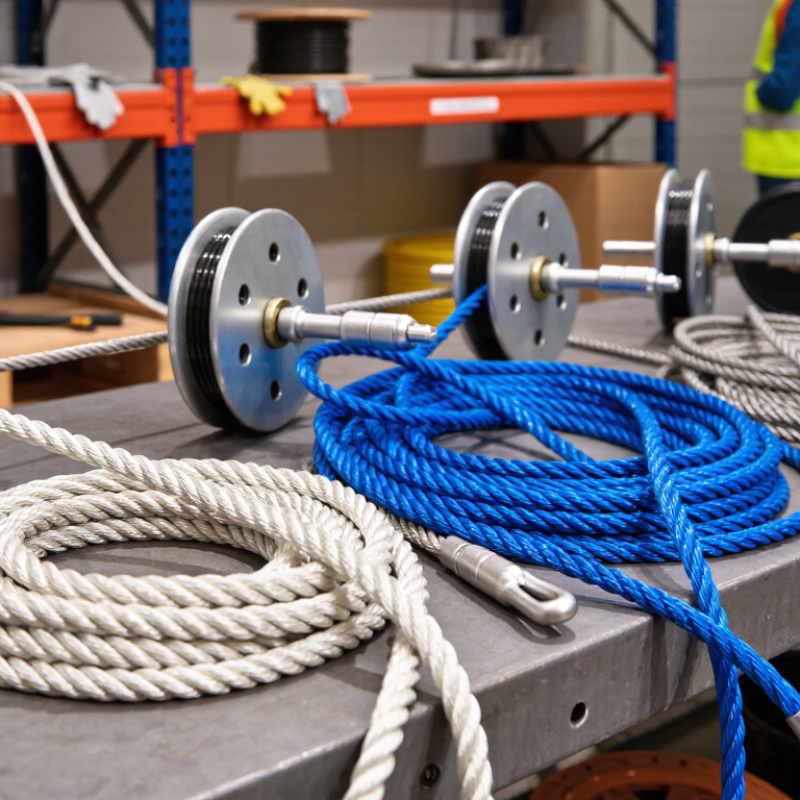
What Is Wire Pulling Rope and How Is It Used?
Wire pulling rope is a low-stretch line used to guide electrical cable through conduit, ducts, and underground pathways. Crews attach the rope to a cable pulling eye or grip, then draw the cable through bends and long runs using a winch or pulling equipment. Its job is simple, but the details matter: rope diameter, construction, rated strength, and compatibility with the pulling setup all affect control and safety. A rope that is too large may bind in a tight conduit. One with inadequate strength can fail under load.
The need for reliable pulling systems is growing. The International Energy Agency’s 2023 report, Electricity Grids and Secure Energy Transitions, estimates that 80 million kilometres of grids must be added or replaced by 2040 to meet climate and energy goals. That is a huge amount of infrastructure work. In practice, installers use braided synthetic ropes for many cable pulls because they are flexible and easy to handle; some applications call for wire rope or specialized low-stretch lines. Check the cable maker’s maximum pulling tension and follow the rope supplier’s working-load guidance. Field conditions can differ from the plan, and that deserves a second look.
Tips: Inspect the full rope before use. Look for cuts, abrasion, crushed sections, or damaged splices. Keep the line aligned with the conduit, and use a swivel where appropriate to limit twisting.
| Rope Type | Construction and Typical Material | Key Characteristics | Common Uses | Buyer Considerations |
|---|---|---|---|---|
| Polyester pulling rope | Usually braided or twisted from polyester fibers. | Low stretch, good abrasion resistance, and relatively low water absorption compared with nylon. | General-purpose pulling in conduit, utility work, and cable installation where controlled elongation is useful. | Check rope diameter, construction, rated strength, and compatibility with the pulling equipment and route. |
| Nylon pulling rope | Typically made from nylon fibers in a braided or twisted construction. | Strong and flexible, with greater stretch under load than polyester. Nylon can absorb water, which may affect its handling and performance. | Pulling applications where flexibility and shock absorption are useful, subject to the manufacturer’s load limits. | Account for elongation and possible water exposure. Do not use stretch as a substitute for correct load control. |
| Polypropylene pulling rope | Made from polypropylene fibers, commonly in twisted or braided form. | Lightweight and buoyant in water; often selected for lighter-duty tasks. Its heat and abrasion performance depend on the specific construction. | Light-duty pulling, temporary lines, and work near water where buoyancy may be useful. | Confirm the rope is suitable for the expected load, abrasion, temperature, and job conditions; avoid assuming all polypropylene ropes have the same rating. |
| Aramid-fiber pulling rope | Built with high-strength aramid fibers, often in a braided rope construction. | High strength for its weight and low stretch. Performance can be affected by bending, abrasion, heat, and exposure conditions, depending on the rope design. | Specialized pulling work where low elongation and a high strength-to-weight ratio are required. | Follow the rope maker’s limits for sheave diameter, handling, inspection, and environmental exposure. |
| Steel wire rope | Multiple steel wires laid into strands around a core. | High strength and low stretch, but heavier and less flexible than many synthetic ropes. It can kink, corrode, or damage cable jackets if mishandled. | Heavy-duty pulling and winch applications when the equipment and job method are designed for steel wire rope. | Inspect for broken wires, corrosion, kinks, and other damage. Use suitable sheaves and approved connections, and keep the rope within its rated working load. |
| What wire pulling rope does: A pulling rope is a line used to draw electrical wire or cable through conduit, ducts, or other pathways. It may be fed through the route first and then connected to the cable, or used with a pulling line and winch. Select rope and accessories based on the cable, route, equipment, rated load, and applicable safety procedures. Never exceed the manufacturer’s working-load limits. | ||||
Related Posts
-
Top 10 Cable Pulling Rope Types for Global Buyers
-
How to Choose the Best Cable Pulling Rope?
-
2025 Top 5 Wire Pulling Ropes for Easy and Efficient Cable Installation
-
High Voltage Wire Best Practices for Global Buyers?
-
China Top Wire Supply Manufacturers You Need to Know?
-
Best Wire Pulling Rope for Your Needs?